
The Art of Hungarian Jewellery: From Traditional Craftsmanship to Modern Elegance
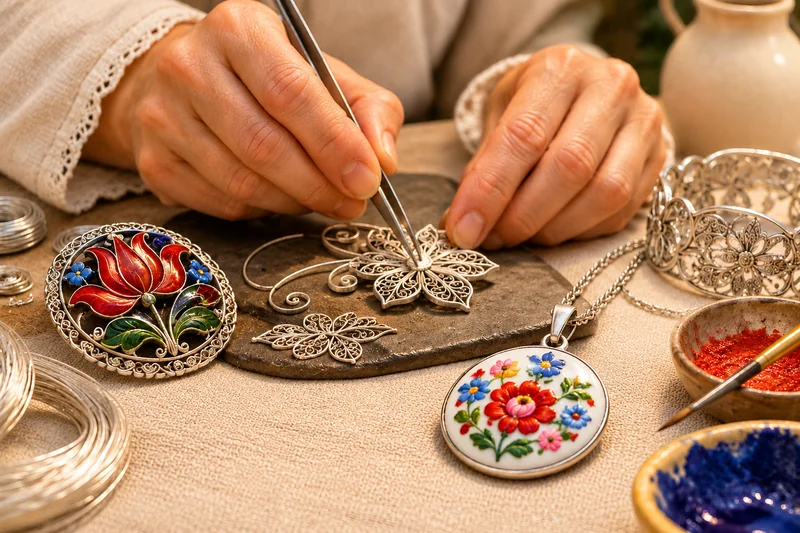
Discover how Hungary's rich artistic heritage continues to inspire beautiful jewellery, from intricate traditional designs to contemporary creations.
Hungary has a long tradition of decorative arts, where craftsmanship, colour and intricate patterns have played an important role in cultural expression.
From beautifully embroidered garments to painted porcelain and elaborate metalwork, Hungarian artisans have developed distinctive ways of transforming everyday materials into objects of beauty.
Jewellery is another fascinating part of this artistic heritage.
Whether fashioned from precious metals, decorated with enamel or inspired by traditional floral motifs, Hungarian jewellery reflects a rich history of creativity and craftsmanship.
Today, contemporary designers continue to reinterpret these traditions, creating pieces that connect the past with modern personal style.
A Heritage of Skilled Craftsmanship
Jewellery has been worn in the Carpathian Basin for centuries, reflecting the changing cultures, artistic influences and social traditions of the region.
Historical jewellery ranged from relatively simple decorative ornaments to elaborate pieces made from silver, gold, gemstones and other materials.
Traditional Hungarian dress often included jewellery and accessories that complemented embroidered clothing, particularly for celebrations and special occasions.
Silver ornaments, decorative beads, pendants and other accessories could express personal taste, regional customs or social standing.
Over time, jewellery-making was also influenced by the skilled metalworking traditions of Central Europe.
Goldsmiths, silversmiths and enamel artisans contributed to a diverse decorative heritage that continues to inspire designers today.
The Beauty of Enamelwork and Filigree
Two decorative techniques associated with European jewellery craftsmanship are enamelwork and filigree.
Enamelwork involves applying powdered glass to a metal surface and heating it until the glass fuses into a smooth, durable decorative layer.
The technique allows artisans to create richly coloured designs, from delicate floral patterns to elaborate geometric compositions.
Hungarian decorative arts include important traditions of enamelled metalwork, particularly in historical and ecclesiastical objects.
Filigree is a different but equally intricate technique. Fine metal wires are twisted, curled and arranged into delicate patterns, often creating an airy, lace-like appearance.
These techniques require patience, precision and considerable skill.
Although not unique to Hungary, they form part of the broader artistic traditions that have influenced jewellery-making throughout the region.
When Hungarian Folk Art Becomes Jewellery
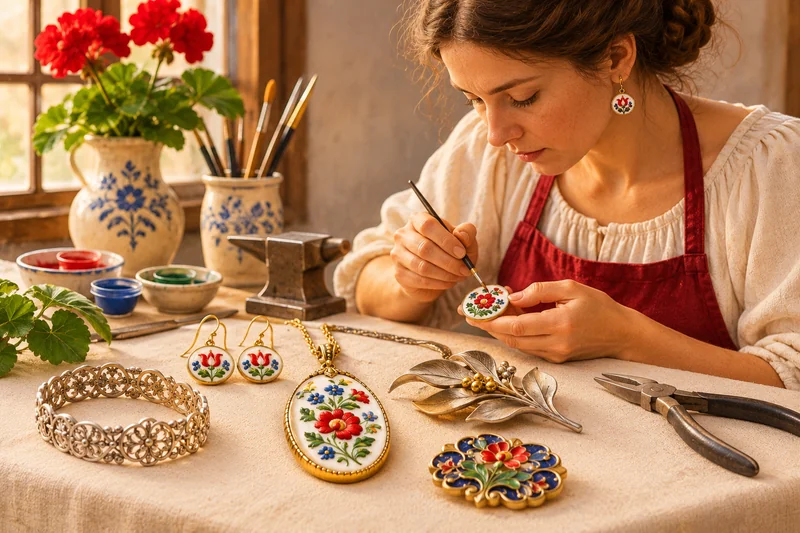
One of the most recognizable features of Hungarian folk art is its love of floral ornamentation.
Roses, tulips, leaves and colourful blossoms appear throughout traditional embroidery, painted furniture, ceramics and decorative textiles.
The famous Kalocsa and Matyó embroidery traditions are especially celebrated for their distinctive floral compositions.
It is perhaps unsurprising that these beautiful patterns have also inspired jewellery designers.
A floral motif that once decorated a traditional blouse can be reimagined as a porcelain pendant, an enamelled brooch or a contemporary pair of earrings.
In this way, jewellery becomes another expression of Hungarian folk art, allowing traditional decorative ideas to find a place in modern wardrobes.
Readers interested in these floral traditions can also explore our article, “The Art of Hungarian Embroidery: From Folk Traditions to Everyday Treasures.”
ZEMA: Hungarian Porcelain Transformed into Jewellery
Porcelain is usually associated with tableware, decorative objects and elegant household collections.
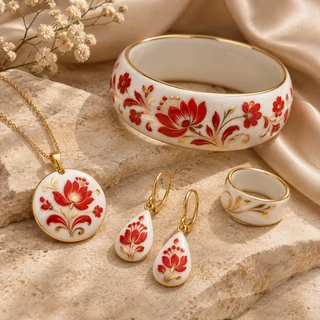
Hungarian jewellery brand ZEMA takes this familiar material in a different direction, transforming porcelain into wearable works of art.
The brand is known for its hand-painted porcelain jewellery, with collections that draw inspiration from Hungarian folk-art traditions.
Some designs incorporate colourful floral motifs reminiscent of traditional embroidery, while others explore more restrained decorative styles.
Porcelain offers a distinctive surface for detailed painting, allowing colours and patterns to become central elements of a piece.
The result is jewellery that brings together two artistic worlds: Hungary's porcelain craftsmanship and its rich heritage of decorative design.
ZEMA's pendants, earrings and other accessories demonstrate how traditional motifs can be adapted into contemporary pieces without losing their cultural character.
For someone who appreciates Hungarian art, these designs offer an interesting alternative to more conventional jewellery materials.
Dorka: A Contemporary Interpretation of Hungarian Inspiration
Not every Hungarian jewellery designer works directly with traditional materials or recognizable folk patterns.
Contemporary jewellery can also express cultural identity through shape, texture, symbolism and individual artistic interpretation.
DORKA S. Jewelry, associated with Hungarian-born designer Dora Kovacs, offers another perspective on this evolving creative landscape.
Born and raised in Budapest, the designer later established her career in New York, bringing her artistic background into a contemporary jewellery setting.
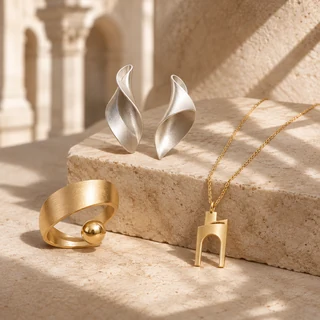
Her work includes sculptural designs that emphasize form and individuality.
Among her creations is a leaf-inspired brooch that draws on the decorative language of traditional Hungarian embroidery.
Rather than reproducing a historic pattern exactly, the design offers a more subtle interpretation of its inspiration.
This approach illustrates how cultural heritage can influence contemporary jewellery without requiring every piece to look traditional.
Sometimes the connection is found in a familiar flower or leaf. At other times, it appears in the designer's approach to craftsmanship and artistic expression.
Hungarian-Inspired Jewellery for Everyday Life
The appeal of Hungarian jewellery lies partly in its variety.
Some pieces celebrate traditional folk art through colourful, recognizable patterns. Others offer a more contemporary interpretation of Hungary's decorative heritage.
There are many ways to enjoy these influences.
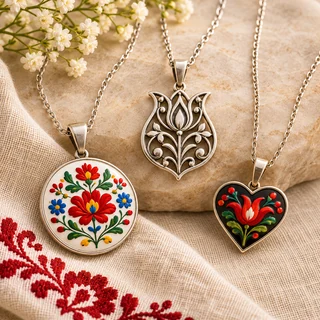
Pendants and necklaces
A floral porcelain pendant or a delicately patterned necklace can introduce Hungarian-inspired design into an everyday outfit.
Earrings
From colourful decorative pieces to more understated contemporary designs, earrings offer a versatile way to enjoy distinctive craftsmanship.
Bracelets
Bracelets featuring decorative motifs, beads or carefully crafted metalwork can make thoughtful gifts.
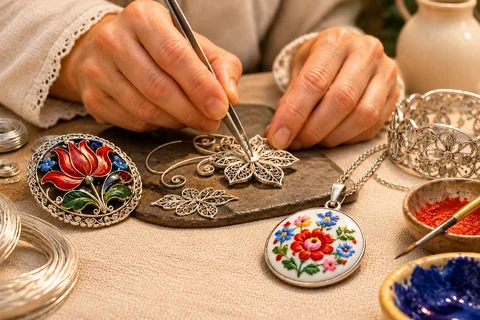
Brooches
Brooches have a particularly interesting connection to decorative traditions. They can transform a simple jacket, scarf or blouse into something more personal.
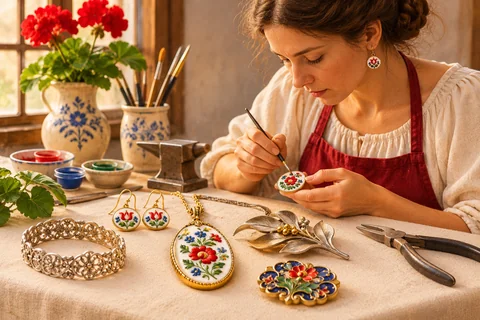
Jewellery sets
Coordinated pieces can make appealing gifts for someone who appreciates artistic accessories or has a special connection to Hungary.
When choosing jewellery, it is worth considering the materials, craftsmanship and origin of the piece.
There is a meaningful difference between jewellery made by Hungarian artisans, designs created by Hungarian designers and mass-produced accessories that simply incorporate Hungarian-inspired patterns.
Each may have its own appeal, but understanding the distinction helps make a purchase more thoughtful.
A Small Treasure with a Personal Story
Jewellery often carries meaning beyond its decorative appearance.
A pendant may remind someone of a family tradition. A floral design might evoke an embroidered tablecloth from childhood or a visit to a Hungarian village.
For people with Hungarian heritage, these connections can be especially personal.
For others, a beautifully designed piece may become an introduction to Hungary's artistic traditions.
A gift does not need to be elaborate to be meaningful. Sometimes a small pendant, a pair of earrings or a carefully chosen brooch can carry a story worth sharing.
Where Tradition Meets Creativity
Hungarian jewellery is not defined by a single material, technique or style.
Its beauty lies in the many ways artisans and designers draw upon the country's artistic heritage.
Traditional metalworking, enamel decoration, porcelain painting and folk-art motifs all contribute to this rich creative landscape.
Designers such as those behind ZEMA and DORKA S. Jewelry demonstrate how differently these influences can be interpreted.
One celebrates the colour and detail of hand-painted porcelain, while the other explores a more contemporary approach to jewellery design.
Together, they remind us that cultural traditions do not have to remain unchanged to remain meaningful.
They can continue to inspire new forms of beauty, creativity and personal expression.
Further Reading
For those interested in exploring Hungarian jewellery, decorative arts and contemporary design, these resources offer additional insights:
- Hungarian National Museum — Explore Hungary's history and material culture, including historical objects, craftsmanship and decorative arts.
- Museum of Applied Arts, Budapest — Discover collections relating to European and Hungarian decorative arts, including jewellery, metalwork, ceramics and enamel.
- ZEMA – Official Website — Explore the brand's hand-painted porcelain jewellery and collections inspired by Hungarian decorative traditions.
- DORKA S. Jewelry – Official Website — Learn more about contemporary jewellery design and the work of Hungarian-born designer Dora Kovacs.