
Szaloncukor: The Sweet Tradition Hanging on Hungarian Christmas Trees
By MagyarImport Editorial Team
How a simple confection became one of Hungary's most beloved Christmas traditions.
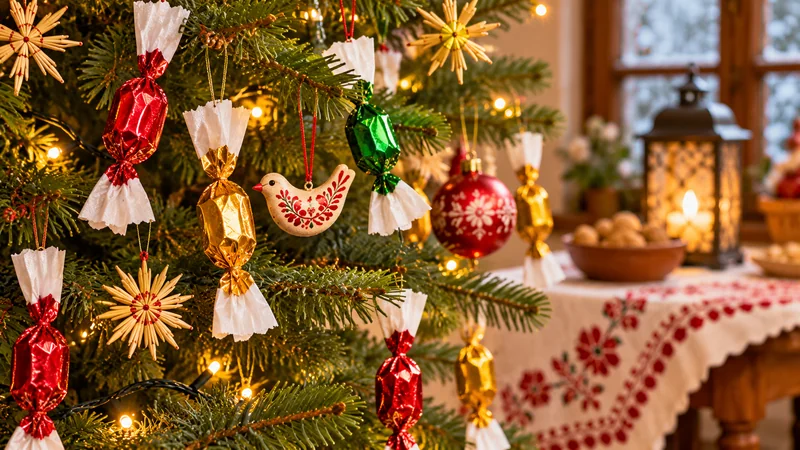
There is something wonderfully familiar about a Hungarian Christmas tree decorated with colourful, foil-wrapped sweets.
Nestled among the ornaments and twinkling lights are little candies with fringed ends, each one hiding a sweet surprise.
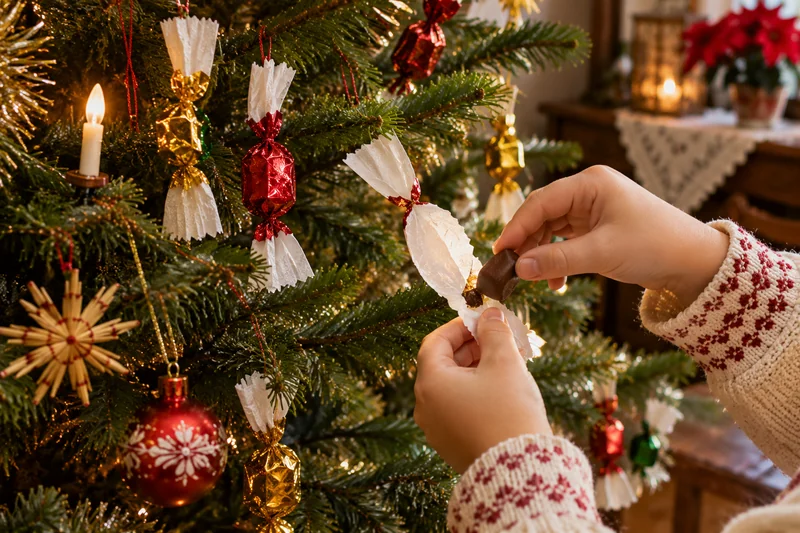
And if you grew up in a Hungarian household, you may remember another familiar sight: perfectly wrapped szaloncukor hanging on the tree, mysteriously empty inside!
But how did this unusual Christmas tradition begin?
From Elegant Salons to Christmas Trees
The story of szaloncukor begins long before the chocolate-covered sweets we know today.
Its roots lie in European confectionery traditions. French fondant sweets and the confectionery fashions of Vienna helped shape the sweet that Hungarian families came to know.
By the nineteenth century, these confections had reached Hungary, where decorated Christmas trees were becoming fashionable among wealthier families.
At the time, Christmas trees were often displayed in the szalon — the elegant reception room where families entertained guests.
Small sweets were offered in these rooms and eventually found their way onto the Christmas tree itself.
The name szaloncukor, meaning roughly “salon candy,” reflects this history. An older Hungarian name for the sweet came from the German Salonzuckerl.
What began as a fashionable European custom gradually became something distinctly Hungarian.
A Christmas Treat with a Literary Connection
The Hungarian Museum of Trade and Tourism records one particularly charming detail. The famous Hungarian novelist Mór Jókai referred to the sweets as szalonczukkedli — an old-fashioned form of the name.
By the late nineteenth century, szaloncukor had become increasingly popular, and Hungarian confectioners were producing an impressive variety of flavours.
In fact, József Hegyesi’s 1891 confectionery handbook described 17 varieties, including pineapple, pistachio and cream bonbons.
So while we often think of modern szaloncukor as having an extraordinary selection of flavours, Hungarian confectioners were already experimenting more than a century ago!
As confectionery production expanded, the sweets became more accessible, eventually finding their way into Christmas celebrations across the country.
The Art of the Wrapping
Part of szaloncukor's charm has always been its distinctive appearance.
Traditionally, each sweet was wrapped in delicate paper, with both ends carefully fringed, then covered with colourful, shiny foil.
Preparing the wrappers was once a time-consuming task, sometimes involving the whole family.
Eventually, special machines were introduced to create the decorative fringes, but the familiar shape remained.
Even today, the colourful wrappers are almost as important to the Christmas atmosphere as the sweets themselves.
From Fondant to Endless Flavours
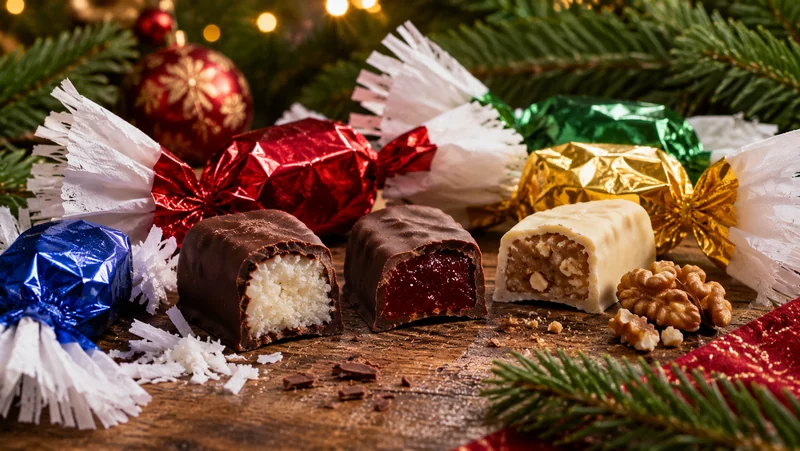
Early szaloncukor was often made from fondant — a soft, sugary confection quite different from many of today's varieties.
Over time, chocolate coatings and new fillings transformed the traditional sweet.
Today, Hungarian shops offer everything from classic fondant and fruit jelly to marzipan, coconut, caramel, walnut and more elaborate chocolate creations.
Artisan confectioners have also brought renewed attention to handmade szaloncukor, offering imaginative flavours and beautifully presented collections.
Yet despite all these changes, the essential tradition remains the same: szaloncukor belongs on the Hungarian Christmas tree.
The Mystery of the Empty Wrappers
Of course, no story about szaloncukor would be complete without mentioning one of its most amusing family traditions.
Somehow, the chocolates have a habit of disappearing from the tree long before Christmas is over.
The cleverest children — and occasionally adults — carefully remove the sweet without disturbing the wrapper, leaving what appears to be a perfectly decorated tree.
Only later does someone discover that several of the beautiful ornaments are completely empty!
It's a small, playful memory shared by generations of Hungarian families.
And perhaps that is what makes szaloncukor so special. More than a Christmas sweet, it is a familiar part of the holiday season — a tradition that connects family celebrations, childhood memories and a little bit of Hungarian history.
Further Reading
- Szaloncukor — Hungarikum Collection (Hungarian)
- Historical account from the Hungarian Museum of Trade and Tourism — Hungarikum nomination dossier (Hungarian PDF)
- Why do Hungarians hang bonbons on their Christmas tree? — Telex
- A karácsonyi szaloncukor története — MÁV-csoport magazin (Hungarian)
For another December tradition, read how Mikulás fills the boots children leave by the window. Our guide to Hungarian celebrations in 2027 follows the holiday year from winter through Christmas.
Magyar Import — Hungarian Heritage • Creativity • Discovery